


SHEET METAL FLATNESS: A STRATEGIC CHALLENGE FOR PRECISION AND CERTIFICATION

In the aerospace and defense industries, aerospace sheet metal flatness is far more than a simple quality requirement. It directly determines dimensional compliance, machining accuracy, and the repeatability of structural assemblies.
As a result, aerospace sheet metal leveling becomes a strategic process for securing production and ensuring the geometric stability of critical components.
Accepted tolerances are extremely stringent, often far tighter than those found in general manufacturing industries, because structural performance and overall aircraft safety depend on them.
Even a slightly warped sheet can create support defects during fixturing, vibration during machining operations, or variations in remaining material thickness.
These deviations may generate assembly defects within the primary structure and non-conformities during final inspection, directly affecting component reliability and certification.

Sheet Metal Flatness and Metallurgical Constraints in Aerospace Manufacturing
Materials used in aerospace applications, such as aluminum alloys, titanium, and superalloys, possess intrinsic properties that directly influence sheet metal flatness.
These materials are characterized by high levels of residual stresses and significant elastic memory, making them particularly sensitive to deformation.
These metallurgical characteristics, combined with pronounced sensitivity to thermal input, require rigorous control of aerospace sheet metal leveling and residual deformation correction after machining.
The release of internal stresses following cutting or machining operations can significantly alter the original flatness condition, even on raw sheet material that initially appears compliant.
Aerospace-grade aluminum alloys such as 2024 aluminum and 7075 aluminum exhibit significantly higher yield strength than standard aluminum grades.
This characteristic makes the correction of warping and the leveling of 7075 aluminum plates and 2024 aluminum plates considerably more challenging after machining operations.
Their behavior varies according to thickness and the redistribution of residual stresses, requiring leveling processes specifically adapted to aerospace materials.
Controlling these phenomena is essential for ensuring the dimensional accuracy of finished aerospace components.
Titanium and Inconel present additional challenges due to their high elastic resilience and intrinsic hardness, making the stabilization and leveling of titanium plates and Inconel plates particularly complex in aerospace environments.
Their pronounced springback characteristics mean that they tend to recover part of their deformation after mechanical loading.
The high hardness of these superalloys also makes machining more difficult and can generate significant thermal stresses.
Precise management of these parameters is essential to prevent degradation of sheet metal flatness.
The behavior of titanium and Inconel, particularly their resistance to permanent deformation, requires specialized leveling techniques.
The elevated temperatures reached during machining may also generate additional stresses, requiring a meticulous approach to material stabilization and compliance of critical aerospace components.

Specific Challenges Associated with Aerospace Sheet Metal
Despite rigorous upstream quality controls, aerospace manufacturers frequently encounter major challenges related to sheet metal flatness.
These issues are often amplified by the precision and reliability requirements that are inherent to the aerospace industry.
Every non-conformity, whether detected before machining or after processing, generates significant consequences.
These may include extensive quality investigations, costly production stoppages, and increased contractual risk, emphasizing the critical importance of maintaining aerospace sheet metal flatness.
Rolling operations frequently generate substantial residual stresses within aerospace sheet metal.
These stresses, invisible to the naked eye, result from plastic deformation of the material and subsequent cooling.
When the sheet is later cut or machined, the release of these internal stresses may generate unexpected deformation, requiring sheet metal leveling or flatness correction prior to assembly.
This phenomenon often appears as warping or dimensional instability, even on components initially considered perfectly flat.
Various forms of geometric distortion can affect sheet metal flatness, each creating unique challenges.
Oil-canning describes a convex or concave surface deformation, while bow refers to longitudinal curvature along the sheet.
Wavy edges are characterized by undulations along the sheet perimeter.
These defects frequently result from uneven rolling conditions or poor control of residual stresses within the material.
Whether in the form of oil-canning, bow, or wavy edges, these distortions directly affect the ability of components to be properly fixtured during machining operations.
They may also compromise assembly precision, generating non-conformities that are critical to the final aircraft structure.
Aerospace Precision Leveler or Sheet Metal Straightener?
The choice between an aerospace precision leveler and a sheet metal straightener depends on the specific objectives of the manufacturing process, the severity of the deformation to be corrected, and the thickness of the plates or machined components.
Each sheet metal leveling technology offers distinct advantages for controlling the flatness of aerospace sheet metal and aerospace components, depending on their condition and their position within the production workflow.
Understanding the capabilities of each machine is essential for optimizing dimensional quality and material stability, thereby ensuring the compliance of critical aerospace components.
Multi-roll straightening, typically performed using a sheet metal straightener, is particularly suitable for sheets and plates prior to major processing operations.
This approach aims to homogenize the distribution of residual stresses throughout the material before transformation begins.
Its primary function is to prepare raw material by establishing stable and uniform sheet metal flatness before cutting or contouring operations, thereby minimizing future deformation.
Sheet metal leveling is particularly relevant for targeted correction applications.
This technique is commonly used on thick plates or structural panels after cutting operations, as well as on machined components exhibiting residual warping.
The intervention of a precision leveler provides highly controlled stress redistribution, which is essential for achieving the strict tolerances required by the aerospace industry.
The use of a precision leveler within aerospace manufacturing represents a strategic production tool.
It is employed for correcting critical production batches and stabilizing material prior to precision machining operations.
This ensures that components meet the highest dimensional requirements while directly contributing to product reliability and certification compliance.
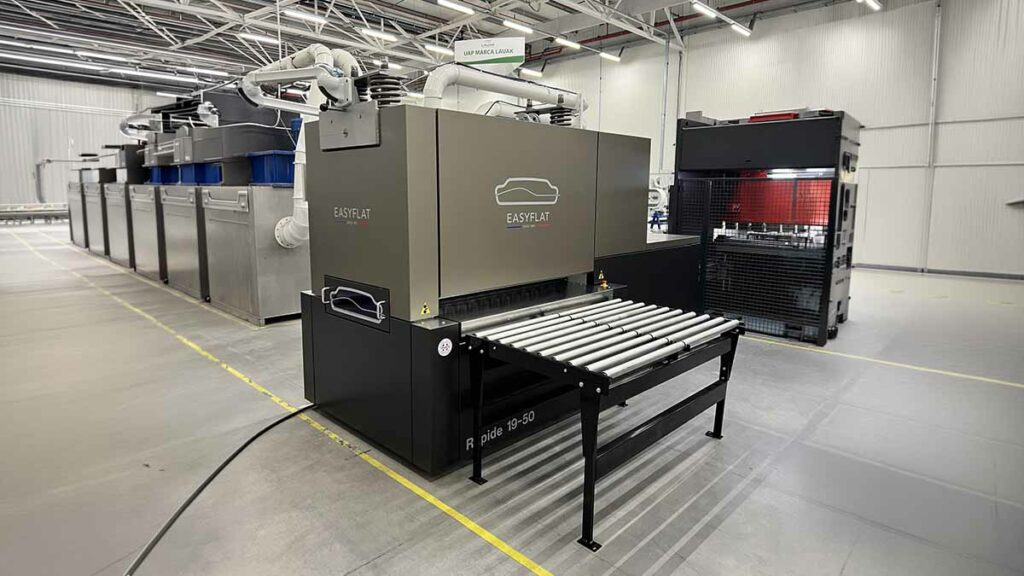
Technological Components of the EasyFlat Precision Leveler
The effectiveness of a precision leveler results from the integration of multiple advanced technologies.
These systems operate together to ensure optimal sheet metal flatness and continuous production performance, transforming sheet material into a stable and highly usable manufacturing substrate.
Overall machine performance depends on the synergy between precision mechanical components and intelligent control systems, ensuring repeatable results across long material lengths and demanding aerospace applications.
Overall machine performance depends on the synergy between precision mechanical components and intelligent control systems, ensuring repeatable results across long material lengths and demanding aerospace applications.
The roll block and backup roll assembly form the mechanical foundation of the EasyFlat precision leveler.
This architecture ensures controlled force distribution across the full width of the material, enabling uniform correction of flatness defects and optimal redistribution of residual stresses.
The EasyFlat digital control system continuously manages leveling parameters and automatically adjusts the roll gap according to material characteristics.
This intelligent adjustment ensures consistent leveling quality, enhanced repeatability, and reduced setup times.
The automatic cleaning system maintains optimal operating conditions by preventing contamination buildup on rolls and contact surfaces.
This contributes to stable leveling performance, extended component life, and consistent sheet metal flatness throughout production.
Nos cas clients
Lauak
Fondé en 1975 sous le nom d’ESKULANAK par son actuel co-gérant, Jean-Marc Charritton…