


SHEET METAL FLATNESS : A MAJOR INDUSTRIAL CHALLENGE FOR PRECISION AND PERFORMANCE
In the manufacturing industry, Sheet Metal Flatness is a critical factor that directly impacts production quality and efficiency.
This sheet metal flatness criterion, often underestimated, is essential for ensuring process accuracy, dimensional accuracy, and finished product compliance.
Sheet metal flatness defects are never random. Rather, they are the visible manifestation of internal stresses and external stresses that accumulate throughout the life cycle of the material.
These sheet metal deformations result from a complex combination of factors, whether inherent to the material itself or induced during the various stages of industrial processing.

Origins of sheet metal deformation and residual stresses
Every stage of the sheet metal manufacturing and processing cycle, from initial rolling to final cutting, leaves a mechanical “memory” within the material. This memory takes the form of Residual Stresses that, if not properly controlled, are released unpredictably and lead to deformation.
The environment in which sheet metal is stored and handled also plays a significant role. Temperature fluctuations, handling methods, and even insufficient stabilization time can intensify pre-existing stresses or create new ones. A comprehensive approach integrating material properties, process conditions, and environmental factors is essential for controlling Sheet Metal Flatness and ensuring product conformity.
Residual Stresses are intrinsic to sheet metal and develop during the earliest stages of manufacturing.
Rolling, whether hot-rolled or cold-rolled, is a major process in which the metal undergoes plastic deformation, generating stress gradients between the surface and the core of the material. These differences in deformation and cooling behavior can leave permanent stresses within the material even after processing is complete.
Likewise, slitting operations and coil winding significantly contribute to the introduction of Residual Stresses. Slitting creates shear and compression zones along the cut edges, while coiling applies uneven pressure to the sheet metal, potentially resulting in residual curvature.
Furthermore, even slight thickness variations within the same sheet represent another source of internal stress. Non-uniform thickness means that the material does not respond consistently to mechanical loads and thermal loads. These heterogeneities create stress imbalances that directly contribute to sheet metal deformation during downstream operations.
Sheet metal processing operations, such as sheet metal cutting, are critical stages during which internal stresses may be released abruptly, resulting in immediate deformation.
Whether through shearing, punching, or Laser Cutting, asymmetric material removal disrupts the stress equilibrium within the sheet. This alteration of the material’s geometry allows stresses to relax, causing movement and deformation.
In addition, localized heating, commonly observed during Laser Cutting or welding, introduces significant thermal loads. These rapid temperature variations create differential expansion and contraction within the sheet metal.
The heated zones expand and then contract during cooling, generating new stresses or amplifying existing ones, resulting in warping or waviness.
Finally, any mechanical impact, even one that appears minor, or the sudden release of internal stresses during punching or a poorly controlled bending operation, can trigger sheet metal deformation. These events act as catalysts, allowing latent stresses to fully express themselves, often in an unpredictable and irreversible manner from a flatness standpoint.

Impacts of Poor Flatness in industrial production
Insufficient Sheet Metal Flatness creates highly tangible consequences in production that extend far beyond simple aesthetics. It causes a loss of accuracy during cutting operations, resulting in dimensional deviations that compromise part integrity. These initial defects can then propagate, affecting downstream manufacturing stages.
In addition, sheet metal instability on the machine table, often caused by poor flatness, makes clamping and fixturing particularly difficult. This challenge leads to an increase in assembly nonconformities, frequently requiring costly and time-consuming manual rework. The overall process slows down, directly impacting production lead times and Productivity.
Automated Production Systems, designed for high-precision manufacturing, are particularly vulnerable to sheet metal flatness variations. A non-flat sheet can cause frequent stoppages in Laser Cutting or plasma cutting systems, disrupting production flow and requiring repeated operator intervention to correct process deviations. These interruptions reduce operational efficiency, uptime, and throughput.
Furthermore, handling and assembly robots that rely on precise geometric data struggle to accurately grip and position distorted parts. This results in assembly errors, potential collisions with equipment, and premature tool wear. The reliability of the entire production system is compromised by these inaccuracies.
Poor flatness is a major contributor to increased Scrap Rates in the metal fabrication industry. Parts exhibiting excessive deformation cannot be used, resulting in a direct loss of raw material and the energy already consumed during the initial manufacturing stages. These losses represent a significant cost for manufacturers.
In addition, operating costs quickly accumulate due to the manual rework required to correct Flatness Defects on potentially recoverable parts. These additional operations require production time, skilled labor, and sometimes dedicated equipment, increasing the unit cost of every manufactured component. Overall Productivity and manufacturing efficiency are negatively affected.
Sheet metal flatnes and material formats: coil vs. plate
Sheet Metal Flatness is essential for ensuring finished product quality. The flatness of a sheet does not depend solely on its thickness or material grade, but also on its supply format and mechanical history.
The two primary formats are Coil-Fed Sheet Metal and Plate Sheet Metal, each presenting specific constraints that directly influence behavior during production. The role of the material format in an industrial flatness strategy is therefore critical.
Coil-Fed Sheet Metal:
Coil-Fed Sheet Metal is the most common supply format, imposing curvature and differential stresses generated by the winding process. This configuration creates shape memory, explaining the material’s natural tendency to curve even after initial uncoiling.
Invisible Residual Stresses originating from the rolling process remain trapped within the material. These stresses become apparent and are released whenever cutting, material removal, or any modification of the mechanical equilibrium is performed on the sheet.
Initially, coil winding generates permanent longitudinal curvature. This deformation is accompanied by differential stresses between the inner and outer fibers of the material, creating an inherent shape memory. Even after uncoiling, the sheet retains a natural tendency to return to its original curvature. This phenomenon is responsible for oil-canning effects and other forms of instability, even when the sheet appears flat at rest.
During uncoiling, the sheet metal undergoes a gradual release of internal stresses. This critical stage may reveal latent defects such as camber or edge waviness, compromising material stability.
As a result, a sheet may appear flat on an inspection table but lose stability as soon as it enters an automated production process. This instability directly impacts cutting repeatability and Dimensional Accuracy.
Consequently, Coil-Fed Sheet Metal often requires corrective action upstream of production. If the material is not stabilized, structural and global defects become amplified during downstream operations, leading to dimensional drift and reduced cutting repeatability.
Plate Sheet Metal: Redistribution after cutting
Produced through blanking from coil, slitting, or custom sizing operations, Plate Sheet Metal no longer exhibits the continuous curvature characteristic of coils. However, the absence of initial curvature does not guarantee perfect stability, as new stress dynamics come into play and influence Sheet Metal Flatness.
When a coil is converted into a plate, internal stress redistribution occurs. This sudden relaxation of certain areas and the appearance of localized deformations are frequently observed following operations such as Laser Cutting, punching, or complex contour cutting.
Defects such as overall warping, dishing, or twisting are commonly observed in Plate Sheet Metal. These deformations are generally localized and directly linked to a specific manufacturing operation, unlike the more global defects encountered in Coil-Fed Sheet Metal.
These instabilities may also become apparent during clamping, where a part that initially appears flat reveals deformation around cut areas, requiring a detailed analysis of Residual Stresses.
Every cutting process, whether Laser Cutting, plasma cutting, or punching, causes a partial and non-uniform release of the sheet metal’s internal stresses. This Stress Redistribution can generate significant localized deformation, negatively affecting Sheet Metal Flatness.
The consequences become visible during bending, assembly, and dimensional inspection, potentially transforming a stable material into an unstable component after machining.
Ultimately, the challenge with Plate Sheet Metal is no longer stabilizing the raw material itself, but restoring Functional Flatness to an already processed part. Part geometry and the type of operation performed are determining factors in the nature and severity of the observed deformations.
The supply format of the material, whether Coil-Fed Sheet Metal or Plate Sheet Metal, directly influences the strategy required to achieve and maintain Sheet Metal Flatness. This distinction is critical because it determines both the nature and the timing of defect occurrence, as well as the most appropriate corrective solutions.
Coils are characterized by global internal stresses and mechanical memory, whereas plates, although already cut, may reveal localized deformation. Understanding these differences is essential for anticipating issues and implementing effective stabilization measures throughout the production process.
The larger the part, the more likely internal stresses from Coil-Fed Sheet Metal are to manifest themselves globally. Large dimensions amplify the effects of longitudinal curvature and Residual Stresses, making stabilization more complex and often requiring more robust Sheet Metal Leveling equipment.
Conversely, for smaller parts produced from Plate Sheet Metal, deformations are generally more localized and directly related to cutting operations. In these situations, the specific geometry of the part becomes a dominant factor in the occurrence and severity of Flatness Defects.

Our cases studies
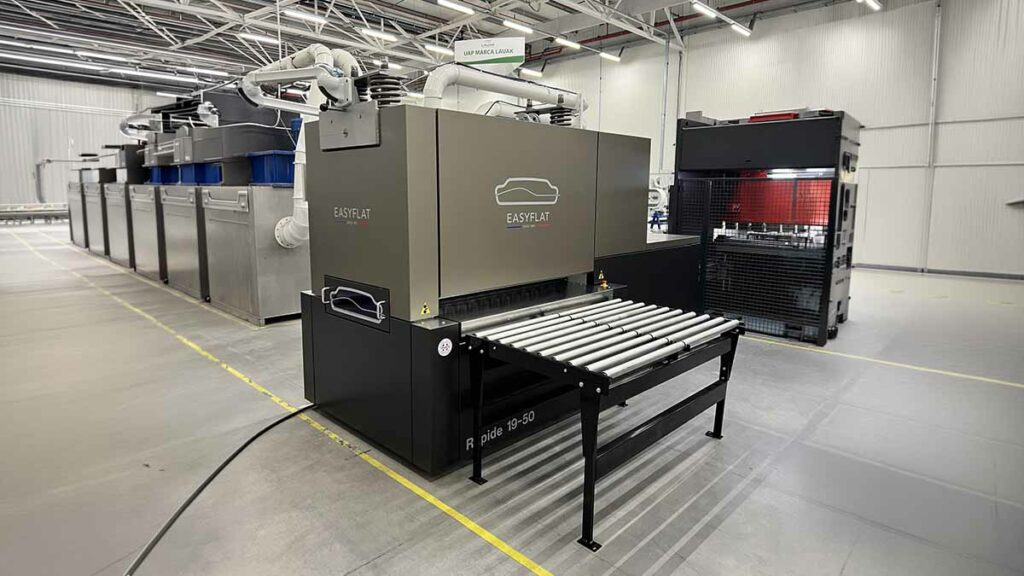
Lauak : Sous-traitant de pièces de structure aéronautique.
Fondé en 1975 sous le nom d’ESKULANAK par son actuel co-gérant, Jean-Marc Charritton, le Groupe LAUAK fournissait des pièces de chaudronnerie à Dassault Aviation. Aujourd’hui, le…