


PERFORATED SHEET METAL FLATNESS: AN AESTHETIC AND STRUCTURAL INDUSTRIAL CHALLENGE
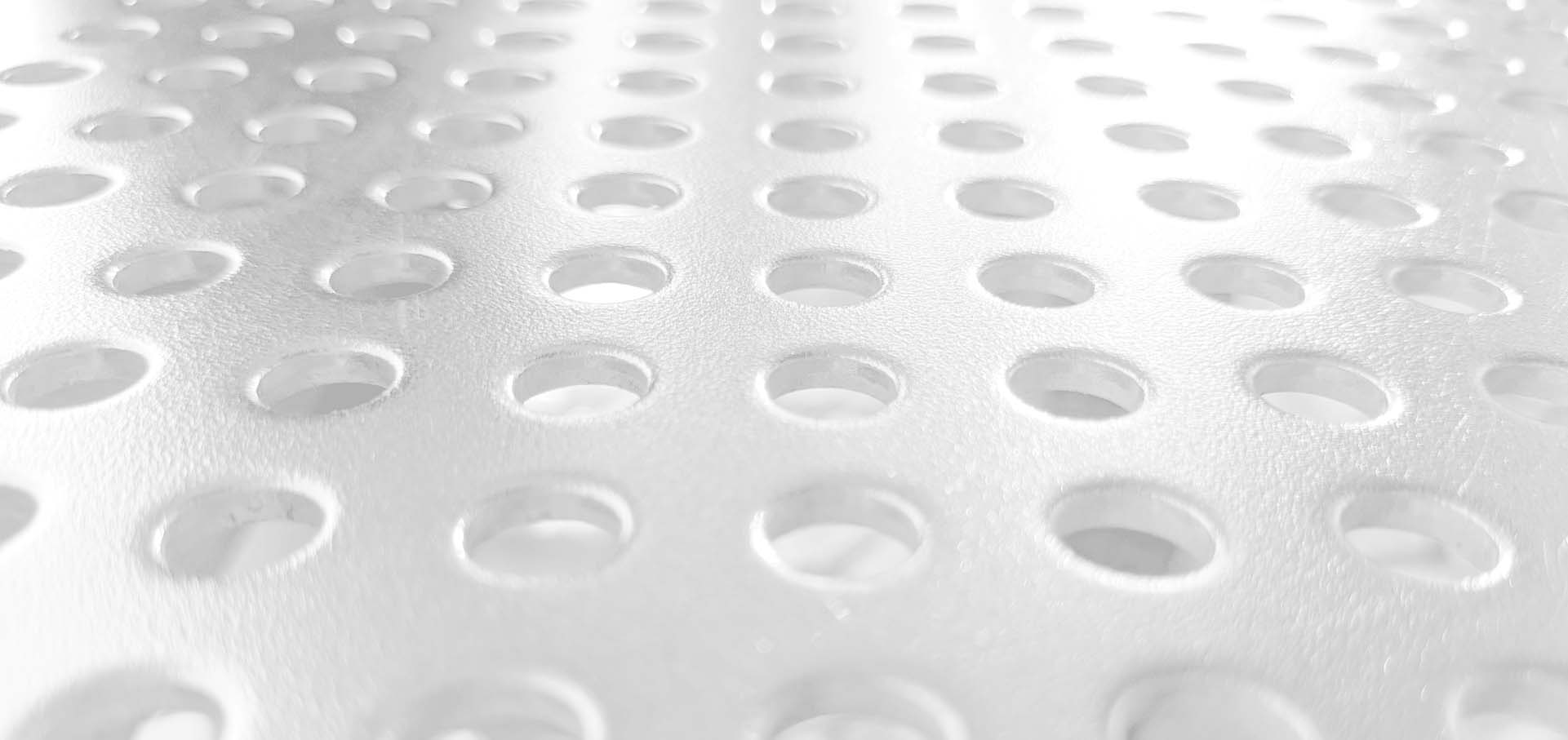
Why Does Perforated Sheet Metal Warp After Laser Cutting or Punching, and How Can This Deformation Be Permanently Corrected Through Leveling?
The flatness of perforated sheet metal is a critical issue that directly impacts architectural appearance, mechanical stability, and the economic viability of industrial projects.
A flatness defect immediately appears through visible waviness, shadow variations, panel misalignment, or loss of geometric accuracy during installation.
Perforation, punching, and laser cutting alter the internal equilibrium of the material by releasing residual stresses and creating zones with different levels of rigidity.
Without proper perforated sheet metal leveling, these imbalances generate warping, camber, or twisting.
In this context, industrial sheet metal leveling performed on cut-to-size perforated sheets restores and permanently stabilizes the geometry of perforated panels.

Why Does Perforated Sheet Metal Warp After Laser Cutting or Punching ?
Understanding the deformation of perforated sheet metal is essential for controlling sheet metal flatness and permanently correcting geometric defects.
Deformation is not an accidental phenomenon – it is the direct mechanical consequence of the perforation process, open-area ratio, and perforation pattern geometry.
Perforation fundamentally alters the internal equilibrium of the material.
Material removal disrupts the initial distribution of residual stresses generated during rolling and creates zones with different rigidity, which are the source of warping and waviness.
The primary causes include:
- release of internal stresses,
- asymmetric distribution of perforations,
- thermal input generated during laser cutting,
- subsequent surface-treatment processes.
Unlike solid sheet metal, perforated sheet metal has a reduced and non-uniform load-bearing cross-section.
Without proper sheet metal leveling, these imbalances may appear or become amplified during transportation, storage, handling, or thermal fluctuations, compromising panel dimensional stability.
Perforations act as stress-concentration zones.
Free edges alter mechanical continuity and locally amplify internal loads.
During punching operations, plastically deformed zones may appear around perforations.
During thermal cutting, thermal gradients intensify the redistribution of residual stresses and promote deformation of the perforated sheet.
The coexistence of solid and perforated areas creates rigidity gradients and locally reduces section inertia.
Solid areas retain their strength, while perforated zones bend more easily.
These differences generate variations in deflection and torsional moments that can create periodic waviness following the perforation pattern and amplify overall panel warping.
Internal stresses redistribute themselves around perforations.
This reorganization locally modifies principal stress directions and generates secondary bending moments that were not compensated for in the original geometry.
When the perforation pattern is asymmetrical or directional, this redistribution becomes unbalanced and promotes differential twisting.
The plate then develops directional behavior that increases sensitivity to warping, camber, and localized buckling, making perforated sheet metal leveling essential for restoring a stable mechanical equilibrium.
The shape of the cutouts directly influences stress concentration.
Sharp corners or elongated openings generate higher stress peaks than circular perforations, increasing the risk of warping.
The spatial arrangement of perforations – including pitch, alignment, and remaining solid areas – determines mechanical continuity and dimensional stability.
A regular matrix distributes loads more uniformly, while an uneven pattern generates deflection gradients and directional imbalances requiring correction through an industrial sheet metal leveler.
Depending on perforation diameter, shape, and spacing, the overall rigidity of the plate changes directionally.
Directional patterns may reduce buckling resistance along a critical axis and increase sensitivity to residual stresses, complicating flatness correction.
The orientation of perforations relative to the rolling direction influences how residual stresses redistribute throughout the material.
The sheet reacts differently depending on whether the perforations follow or cross the rolling direction and the material’s mechanical anisotropy.
This interaction can generate directional imbalances and differential twisting.
The plate naturally deforms in search of a new mechanical equilibrium, potentially increasing waviness and warping if no correction is performed using an industrial sheet metal leveler specifically adapted to perforated sheet metal.
Deformation appears in the form of overall warping, camber, oil-canning, or localized buckling between perforated zones.
When compressive stresses exceed the local critical load – which is reduced by the lower moment of inertia caused by the open-area ratio – localized buckling may occur.
These defects may initially appear minor after cutting but later reveal themselves or become amplified during transportation, storage, heat treatment, or climatic variations, exposing latent mechanical instability.
Without proper perforated sheet metal leveling, deformation may compromise panel dimensional stability.
Stabilization is not limited to eliminating a visible defect.
It involves controlled redistribution of residual stresses to achieve a stable and repeatable mechanical equilibrium.
Properly leveled perforated sheet metal demonstrates greater resistance to future disturbances—whether thermal, mechanical, or handling-related—and maintains its flatness over time, provided no significant new structural imbalance is introduced.

Perforated Sheet Metal Flatness: Complementarity Between a Straightener and an Industrial Precision Leveler
The distinction between a perforated sheet metal straightener and an industrial precision leveler is fundamental for ensuring perforated sheet metal flatness after punching or laser cutting.
Flatness depends as much on open-area ratio and perforation geometry as on the initial condition of residual stresses.
The challenge becomes one of balancing solid and perforated zones through a mechanical action capable of redistributing tensile and compressive loads across the full thickness of the panel.
When sheet metal has already been perforated or cut to size, corrective intervention becomes necessary.
The multi-roll industrial precision leveler, through controlled and progressive alternating bending, corrects deformation, reduces warping and camber, and permanently stabilizes perforated panel geometry without compromising downstream process repeatability.
Punching locally generates plastically deformed zones around perforations.
These areas concentrate residual stresses and create mechanical gradients that may cause waviness, oil-canning, or localized deformation.
To permanently correct perforated sheet metal, these stresses must be redistributed uniformly throughout the entire panel.
The industrial precision leveler accomplishes this by applying a sequence of controlled alternating bends that slightly exceed the material’s yield strength.
This controlled plastic deformation rebalances tensile and compressive forces throughout the thickness and stabilizes sheet metal flatness.
Oil-canning occurs when differences in rigidity between solid and perforated areas create localized hinge points.
On large panels or sheets with high open-area ratios, these imbalances may self-amplify and generate visible waviness.
Camber corresponds to an overall deflection resulting from stress imbalance throughout the thickness.
Its correction requires precise roll penetration adjustment, appropriate roll density, and sufficient mechanical support to eliminate deformation without generating new instability.
A sheet metal straightener operates on solid or minimally processed sheets.
Its purpose is to homogenize the distribution of residual stresses generated during rolling and correct simple deformation before further processing.
Through progressive alternating bending applied to a mechanically homogeneous section, it stabilizes the initial geometry of the material.
This preventive action improves repeatability in cutting and perforation operations by reducing stress variability and securing initial sheet metal flatness.
In the context of perforated panels, a straightener can be used upstream while the sheet remains solid.
However, once perforation introduces a significant open-area ratio, the mechanical challenge becomes more complex and generally requires an industrial precision leveler with high roll density adapted to contrasting rigidity zones.
The precision leveler is the preferred solution for correcting perforated sheet metal that has already been transformed, cut, or punched.
Its high-density roll architecture, exceptional frame rigidity, and precise penetration adjustment enable progressive alternating bending capable of treating areas with contrasting rigidity and reduced load-bearing sections.
Unlike localized straightening methods, multi-roll sheet metal leveling provides uniform and controlled redistribution of residual stresses across the entire perforated panel.
The result is durable stabilization of warping, camber, and differential twisting, ensuring reliable and repeatable flatness over time.
Alternating bending generates successive cycles of tension and compression that promote redistribution of residual stresses throughout the sheet thickness.
When necessary, deformation slightly exceeds the material’s yield strength, creating controlled plastic deformation and minimizing elastic springback responsible for warping.
Precise control of bending amplitude, roll penetration, and progressive loading is essential.
Poorly calibrated correction can generate secondary waviness or localized buckling, whereas optimized settings provide uniform and long-lasting stabilization.
Roll penetration settings must be adapted to sheet thickness, open-area ratio, and overall panel rigidity.
High roll density reduces individual bending amplitude and ensures progressive cumulative action, making it particularly effective for perforated sheet metal leveling.
Repeatable settings, frame rigidity, and high-quality mechanical support systems determine final leveling quality.
Precise adjustment enables correction of complex deformation while ensuring long-term dimensional stability for demanding architectural and industrial applications.
Choosing Between a Straightener and a Precision Leveler for Correcting Perforated Sheet Metal
The choice between a sheet metal straightener and a precision leveler is not determined solely by machine type but by the actual mechanical behavior of the sheet being corrected.
Several factors determine the most suitable solution:
- thickness,
- yield strength,
- open-area ratio,
- perforation geometry,
- degree of processing already completed.
These factors directly influence residual rigidity and the way residual stresses redistribute throughout the panel.
A sheet metal straightener is appropriate when the sheet remains solid or has undergone minimal processing.
Its purpose is to:
- homogenize rolling-induced stresses,
- correct simple global deformation,
- stabilize geometry before cutting or perforation.
In this case, the section remains mechanically homogeneous and correction primarily focuses on balancing internal stresses across a uniform thickness.
As soon as material removal modifies the load-bearing section – as in the case of perforated sheet metal – the mechanical challenge fundamentally changes.
Deformation no longer results from a global imbalance but rather from:
- rigidity differences between solid and perforated zones,
- localized stress gradients,
- oil-canning and camber phenomena.
Under these conditions, an industrial precision leveler becomes necessary to permanently correct deformation and stabilize panel geometry.
The primary criterion is not simply thickness but the machine’s ability to process non-uniform stress distribution.
A precision leveler adapted to perforated sheet metal leveling must provide:
- high roll density for progressive alternating bending,
- exceptional structural rigidity,
- precise penetration adjustment,
- industrial repeatability ensuring long-term flatness stability.
By contrast, a straightener operates on a mechanically homogeneous section and cannot effectively compensate for localized rigidity contrasts after perforation.
Material characteristics also play a major role.
High yield strength or pronounced metallurgical memory requires carefully controlled mechanical loading.
- Thin sheets with high open-area ratios require progressive correction to avoid secondary buckling.
- Greater thicknesses require machine structures capable of absorbing significantly higher forces.
Selecting a leveling solution therefore requires balancing bending amplitude, adjustment precision, and structural robustness in order to achieve durable sheet metal flatness.
The primary criterion for choosing between a sheet metal straightener and a precision leveler remains the machine’s ability to process the stress level and residual rigidity generated by perforation geometry, thickness, material yield strength, and open-area ratio.
The choice of industrial leveling or straightening equipment should therefore be based on a detailed mechanical analysis of the component and the depth of the residual stresses that must be redistributed to ensure controlled industrial flatness.
Perforated Sheet Metal Flatness: An Industrial Economic Challenge
It reduces scrap, delivery delays, workshop rework, and contractual risks.
Well-controlled sheet metal leveling optimizes production costs, secures customer commitments, and strengthens technical credibility.
By reducing scrap rates, improved flatness increases material yield and allows better utilization of plates and cut formats, minimizing waste and cutting losses.
Stable geometry also improves nesting efficiency and cutting layouts, increasing the number of compliant parts produced per batch.
As soon as a visible defect appears, financial consequences multiply:
- project rejection,
- replacement demands,
- contractual penalties.
These costs frequently exceed the investment required for proper perforated sheet metal leveling.
Because non-conformance generates delays, non-productive labor hours, and after-sales service costs, systematic correction of deformation significantly reduces these indirect expenses while protecting technical reputation.
Any industrial precision leveler adapted to perforated panels improves delivery reliability, secures contractual commitments, and optimizes profitability by reducing hidden costs.
Criteria for a Leveling Solution Adapted to Perforated Sheet Metal
A leveling solution adapted to perforated sheet metal requires a specific machine architecture.
It must combine:
- high roll density,
- exceptional frame rigidity,
- precise and progressive penetration adjustment,
- adaptation to open-area ratios,
- high industrial repeatability.
These characteristics are essential for ensuring stable, durable, and repeatable flatness on perforated panels exhibiting contrasting rigidity zones.